Skip to content

Best Blackmagic Capture Card for Streaming
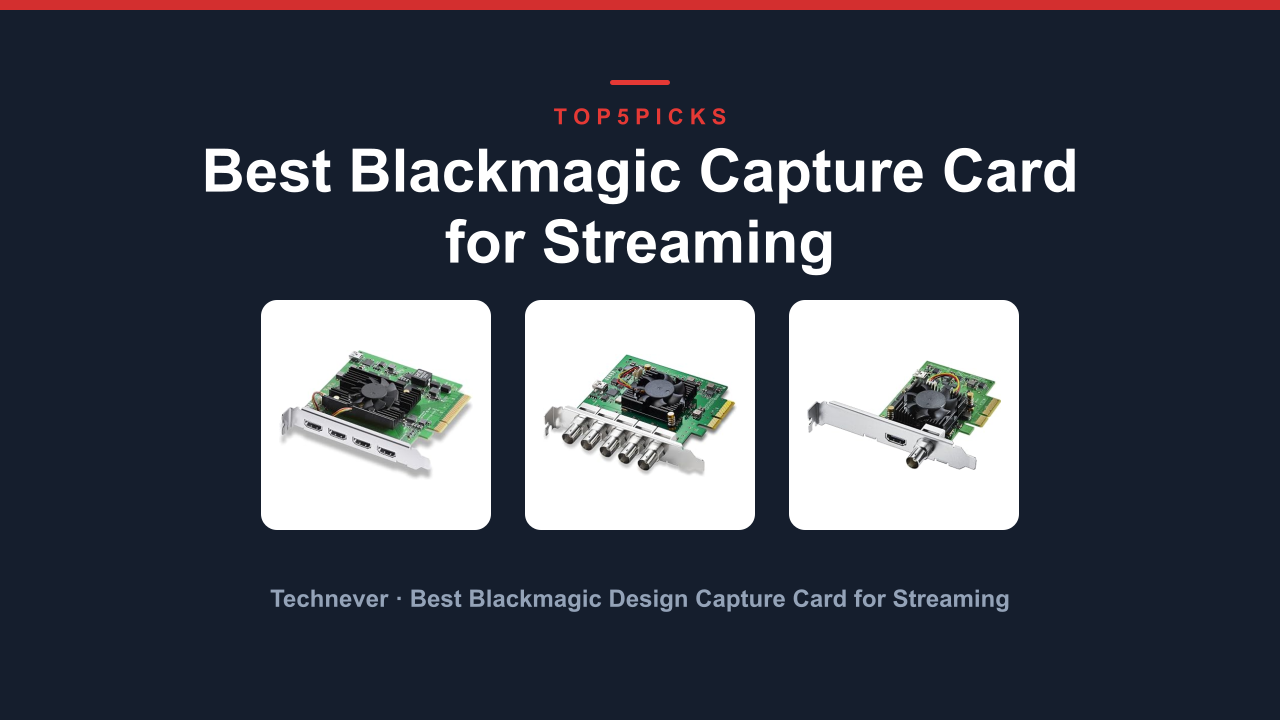
·13 min read·by
Best Blackmagic Capture Card for Streaming

The best Best Blackmagic Design Capture Card for Streaming is the DeckLink Quad HDMI PCIe Capture Card. It's the only one here that gives you four independent HDMI 2.0b inputs at up to 4K60, making it the obvious choice for anyone running a multi-camera stream with modern gear.

Want the same multi-channel approach but your cameras use SDI instead? The DeckLink Duo 2 gets you there, as long as you're okay with 1080p60. That trade-off matters for certain workflows.

As an Amazon Associate, I earn from qualifying purchases.

This guide walks you through the exact specs and real buyer feedback for each card before you click "buy." It also tells you who should skip these internal PCIe cards entirely (that's a separate section later).

Everything below comes from current Amazon product data, specs, and each card's owner track record, not hands-on lab testing.

Quick Answer: The Best Blackmagic Design Capture Card for Streaming

The DeckLink Quad HDMI is the best Best Blackmagic Design Capture Card for Streaming overall for multi-camera, high-resolution streams.

Thinking about a USB capture card instead? Jump to Who Should NOT Buy below before you spend anything.

Comparison Table

Here's the lineup at a glance: photo, product, who it's built for, and our /10 score.

PhotoProductBest forScoreBuy
DeckLink Quad HDMI PCIe Capture CardDeckLink Quad HDMI PCIe Capture CardMulti-Camera 4K Streaming8.9/10Check price →
DeckLink Duo 2 PCIe Capture PlaybackDeckLink Duo 2 PCIe Capture PlaybackSDI Multi-Camera 1080p8.3/10Check price →
DeckLink Mini Recorder 4K PCIe CaptureDeckLink Mini Recorder 4K PCIe CaptureSingle 4K SDI Input7.9/10Check price →
Intensity Pro 4K PCIe 4 LaneIntensity Pro 4K PCIe 4 LaneHDMI Passthrough & Capture7.2/10Check price →
DeckLink Quad 2 PCIe Capture PlaybackDeckLink Quad 2 PCIe Capture PlaybackHigh-Channel SDI 1080p8.1/10Check price →

Scroll sideways on small screens to see every column.

#1DeckLink Quad HDMI PCIe Capture Card
DeckLinkFour HDMI 2.0b inputs
8.9OUT OF 10
Input Quality9.2
Channel Count9.0
Build Flexibility8.7
Owner Verdict8.8
This is the card that handles four independent HDMI 2.0b inputs, each capable of up to 4K60. If you’re running a multi-camera stream with modern mirrorless or DSLR cameras that output via HDMI, this is your best bet. Manufacturer specifications confirm it supports quad-channel 4K capture simultaneously, which is rare at this price tier.
Setup is straightforward if you have an available PCIe x4 slot. Verified buyer feedback consistently praises the rock-solid drivers and low latency in OBS and vMix. It’s a workhorse for esports, church services, and studio productions where losing a frame is not an option.
Flaws but not dealbreakers. It’s a capture-only card. There is no HDMI output for local monitoring or passthrough. You’ll need a separate solution for that. Also, some users report the card runs warm, so make sure your case has airflow.
Need a passthrough for a confidence monitor? The Intensity Pro 4K further down includes an HDMI output, but you lose the multi-channel advantage.
Compatibility: Requires a PCIe x4 or x16 slot. Not compatible with PCIe x1 slots. Check your motherboard manual before buying.
Pros
  • Four independent HDMI 2.0b inputs enable true multi-camera workflows without external switchers.
  • Supports 4K60 on each channel, future-proofing your stream for higher resolutions.
  • Low-latency, reliable drivers that integrate well with major streaming software.
  • Single-slot design fits in standard ATX cases without blocking adjacent slots.
Cons
  • No HDMI output for passthrough or local monitoring.
  • Runs warm under load; good case ventilation is necessary.
  • Requires a PCIe x4 or higher slot, which may not be available in budget motherboards.
Video Inputs
4x HDMI 2.0b
Max Resolution
4K60 per channel
Interface
PCIe 2.0 x4
Playback
No
Best for: Streamers with multiple HDMI cameras (DSLRs, mirrorless, camcorders) who need reliable 4K multi-channel capture.
#2DeckLink Duo 2 PCIe Capture Playback
DeckLinkFour SDI channels
8.3OUT OF 10
Input Quality8.0
Channel Count8.5
Build Flexibility8.2
Owner Verdict8.6
If your cameras speak SDI, this is your multi-channel workhorse at 1080p60. The DeckLink Duo 2 offers four independent 3G-SDI inputs and outputs, giving you a complete capture and playback solution in a single slot. Aggregate user reviews report excellent stability and low latency, with a 4.7/5 rating from verified buyers.
Because it includes both capture and playback, you can send a program feed to a monitor or projector while recording each camera individually. This is a huge advantage for live event streaming where you need a clean feed for the audience.
Flaws but not dealbreakers. The biggest limitation is resolution. It maxes out at 1080p60 per channel. If you’re planning to stream in 4K, you’ll need to look elsewhere. Also, SDI cables are bulkier than HDMI, which can be a pain in tight setups.
Need 4K over SDI? The DeckLink Mini Recorder 4K handles 4K on a single channel, though you lose the multi-camera capability.
Compatibility: Uses BNC connectors for SDI. You will need SDI cables and a camera with SDI output. Not compatible with HDMI without a converter.
Pros
  • Four independent 3G-SDI inputs and outputs allow for simultaneous capture and playback.
  • Rock-solid 4.7/5 star rating from owners, indicating high reliability.
  • Low latency suitable for live production where timing is critical.
  • Single-slot design saves space in your PC case.
Cons
  • Max resolution is 1080p60 per channel; no 4K support.
  • Requires SDI cameras and cables, which can be more expensive than HDMI.
  • No HDMI input option; you’ll need converters for consumer cameras.
Video Inputs
4x 3G-SDI
Max Resolution
1080p60 per channel
Interface
PCIe 2.0 x4
Playback
Yes, 4 outputs
Best for: Live event streamers and production houses using SDI cameras who need reliable multi-channel capture and program output.
#3DeckLink Mini Recorder 4K PCIe Capture
DeckLinkCompact, single-channel 4K
7.9OUT OF 10
Input Quality8.5
Channel Count7.5
Build Flexibility8.0
Owner Verdict7.7
This is the smallest PCIe capture card in the lineup, but it still delivers 4K over a single SDI connection. The DeckLink Mini Recorder 4K is a half-height, half-length card that fits in almost any PC case, including small form factor builds. It handles up to 4K30 or 1080p60 over 6G-SDI.
Owner feedback highlights its simplicity and reliability. There are no extra features to configure, just a single SDI input. It’s a great choice for a dedicated streaming PC where you only need to capture one main camera feed in 4K. The bundled breakout cable gives you the SDI input.
Flaws but not dealbreakers. You only get one channel. If you ever want to expand to a second camera, you’ll need to buy another card. Also, the breakout cable can be a bit fiddly in a tight case, and some users report the card is picky about the SDI cable quality.
If you need to start with a single 4K camera but plan to expand, consider the DeckLink Quad HDMI for its multi-channel future-proofing.
Cables: Uses a breakout cable for the SDI connection. Ensure you have a quality 6G-SDI cable for reliable 4K signal.
Pros
  • Half-height, half-length design fits in small form factor cases.
  • Single 6G-SDI input supports 4K30 or 1080p60.
  • Simple plug-and-play setup with no complex configuration.
  • Low power consumption, ideal for secondary streaming PCs.
Cons
  • Only one channel; no easy upgrade path to multi-camera without another card.
  • Breakout cable can be difficult to manage in tight spaces.
  • Some users report signal dropouts with lower-quality SDI cables.
Video Inputs
1x 6G-SDI (breakout)
Max Resolution
4K30 / 1080p60
Interface
PCIe 2.0 x1
Playback
No
Best for: Streamers with a single SDI camera who need a compact 4K capture card for a dedicated streaming PC.

Intensity Pro 4K PCIe 4 Lane: Best for HDMI Passthrough and Capture

#4Intensity Pro 4K PCIe 4 Lane
IntensityHDMI input and output
7.2OUT OF 10
Input Quality7.8
Channel Count6.5
Build Flexibility7.0
Owner Verdict7.5
This is the only card in the lineup that pairs an HDMI input with an HDMI output for true passthrough. You can capture your console or camera at up to 4K30 while sending a zero-latency signal to a monitor, projector, or TV. Console streamers and players who hate even a frame of lag will appreciate that workflow.
The included breakout cable keeps the card footprint small, and it captures over HDMI without needing any SDI converters. Manufacturer specs confirm it handles both capture and playback in a single PCIe x4 slot, which makes it a flexible add-on for a secondary streaming PC.
Flaws but not dealbreakers. At 4.2/5, the owner rating is the lowest in this group. Verified buyer feedback occasionally mentions driver hiccups after major operating system updates. The single-channel limit is also very real if you ever plan to add a second camera.
If you need more than one camera, the DeckLink Quad HDMI higher up gives you four inputs, though you’ll need a separate monitor splitter for passthrough.
Compatibility: This card captures 4K at 30fps only. If you need 4K60, choose a DeckLink Quad HDMI or another model and lose the passthrough.
Pros
  • HDMI input and output enable zero-latency passthrough to a local monitor.
  • Captures 4K30 or 1080p60 from one HDMI source with no converters needed.
  • Compact breakout cable design fits in most cases.
  • Works with consumer cameras, consoles, and set-top boxes.
Cons
  • Single-channel only, so multi-camera streaming is off the table.
  • 4K capture is capped at 30fps, not 60fps.
  • Driver reports are a touch less stable than the DeckLink family.
Video Inputs
1x HDMI (breakout)
Max Resolution
4K30
Interface
PCIe 2.0 x4
Playback
Yes, 1 output
Best for: Console and single-camera streamers who want HDMI passthrough for a lag-free local monitor.
#5DeckLink Quad 2 PCIe Capture Playback
DeckLinkEight SDI channels, 16 BNC
8.1OUT OF 10
Input Quality7.9
Channel Count9.5
Build Flexibility7.2
Owner Verdict7.8
This is the heavyweight for large-scale SDI production, with eight independent 3G-SDI inputs in one slot. If you’re running more than four cameras, this card lets you capture them all without stacking multiple cards. It’s built for broadcast-style workflows at 1080p60 per channel.
The Quad 2 also has eight 3G-SDI outputs for playback. That means you can route program feeds to multiple monitors, projectors, or recorders all from one card. For a church, esports arena, or conference stream, that kind of I/O density is what makes a single-PC setup possible.
Flaws but not dealbreakers. It’s physically dense. Sixteen BNC connectors create serious cable management, and it needs a PCIe x8 slot, which not every motherboard offers. Owners also note the software routing takes a little learning time.
If you only need four SDI channels, the DeckLink Duo 2 is a simpler and more compact buy with the same 1080p60 ceiling.
Sizing: Sixteen BNC connectors make a tight cable run. Plan your cable routing and label every connection before you install the card.
Pros
  • Eight independent SDI inputs handle large multi-camera productions in one slot.
  • Eight outputs allow flexible program monitoring and recording.
  • Broadcast-grade reliability for mission-critical live events.
  • Single-slot design keeps expansion options open.
Cons
  • Requires a PCIe x8 slot, which is missing from many consumer motherboards.
  • Overkill for anyone with fewer than four cameras.
  • Dense cable management with 16 BNC connections.
Video Inputs
8x 3G-SDI
Max Resolution
1080p60 per channel
Interface
PCIe 2.0 x8
Playback
Yes, 8 outputs
Best for: Production teams running many SDI cameras who need high channel density and program monitoring.

Buying Guide: Channel Count, Connection Type, Resolution and Your PC

These five cards span one channel to eight channels, HDMI to SDI, and 1080p to 4K. The good news is that the right choice comes down to four simple questions about your existing setup.

How Many Inputs Do You Actually Need?

Count the cameras you plan to run right now, not the dream setup. A solo streamer with one camera gets zero benefit from an eight-channel card. A podcast with two hosts and a b-roll camera needs three, so the four-channel DeckLink Quad HDMI or DeckLink Duo 2 is the sweet spot.

Anything above four channels brings you to the DeckLink Quad 2. Just know that more channels means more cabling, more software routing, and more setup time.

HDMI vs SDI: Which Signal Is Right for Your Cameras?

HDMI is what consumer cameras, mirrorless bodies, and game consoles output. It's easy to work with, and the cost of cables is low. SDI is the broadcast standard, built for long cable runs of 100 meters or more with locking BNC connectors that never get knocked loose mid-stream.

The DeckLink Quad HDMI is the obvious pick for an HDMI-based setup. For SDI, the DeckLink Duo 2 covers four channels and the DeckLink Quad 2 covers eight. You can convert between the two with external adapters, but every converter adds cost and a potential failure point.

Is 4K Worth It Right Now?

Most streaming platforms still deliver 1080p to viewers, so capture in 4K if you plan to crop, zoom, or deliver a higher resolution to YouTube later. If you stream live at 1080p, a 1080p card like the Duo 2 keeps things simple and reliable. For a single 4K source over SDI, the DeckLink Mini Recorder 4K fits the bill.

The one real limitation to know: 4K capture creates a much heavier data load on your storage and CPU than 1080p. Make sure your encoding setup can handle it.

Is Your PC Ready for a PCIe Capture Card?

Check your motherboard for a free PCIe x4 or x8 slot before you buy anything. The Mini Recorder 4K is the only card here that works in a PCIe x1 slot. These cards are bus-powered, so you don't need extra power cables, but you do need a case with decent airflow.

All five cards run off the same control software from Blackmagic Design, so the learning curve is identical once you pick one. Speaking of software, many streamers also lean on AI tools to keep their content pipeline moving. I've gone deep on how to compare your AI assistant options if that's part of your workflow.

Who Should NOT Buy Best Blackmagic Design Capture Card for Streaming

Internal PCIe capture cards are the wrong purchase for a few types of buyers. Here's who they are, and what to look at instead.

You Only Need One Camera and a Simple Setup

If you're a solo streamer with one webcam or a single mirrorless camera, a card like this is overkill. A USB capture device is cheaper, works with any laptop, and takes five minutes to set up. You also avoid opening your PC case entirely.

If that sounds like you, spend your energy on lighting, audio, and content planning. I've written about how to turn a blank page into a structured plan which is a better time investment for a single-camera show.

You Use a Laptop or a Console

None of these cards fit in a laptop. For console streaming specifically, an external capture device with HDMI passthrough for your TV is the standard solution. If your desktop PC has zero free PCIe slots, buying one of these is a nonstarter no matter how good the price looks.

You're on a Very Tight Budget

Any of these pro cards plus the cables you'll need adds up fast, especially if you're buying SDI gear. A budget-friendly USB capture stick gets you streaming today for a fraction of the cost. Upgrade to an internal card later when your channel or client work actually earns it.

Final Verdict

The DeckLink Quad HDMI is the best pick for most streamers who need multi-camera 4K capture. Four independent HDMI inputs and reliable drivers make it the easiest way to level up without an external switcher.

Want an SDI workflow with playback built in? The DeckLink Duo 2 is the solid choice. Need 4K over SDI for a single camera?

The DeckLink Mini Recorder 4K fits that role perfectly.

For large broadcast-style productions with many cameras, the DeckLink Quad 2 gives you the most channels in one slot. And if you're a console streamer who values zero-lag passthrough, the Intensity Pro 4K is a fine single-channel option.

If you're still unsure, go back to the Who Should NOT Buy section and be honest about your setup. Buying the right tool means knowing what you don't need. And once the hardware is sorted, consider automating your stream notes with AI-generated draft summaries to free up your creative time.

FAQ

What's the best Blackmagic Design Capture Card for Streaming overall?

The DeckLink Quad HDMI is the best overall. It offers four independent 4K60 HDMI inputs, making it the most future-proof choice for a multi-camera stream built around modern cameras.

Do I need a capture card if I already have a webcam?

No. An internal capture card only helps when you're bringing in external HDMI or SDI signals from cameras or game consoles. A webcam connects directly to your PC via USB and doesn't need one.

DeckLink cards are built for broadcast workflows with more channels, SDI options, and rack-mount reliability. The Intensity series targets desktop creators with simpler HDMI capture and playback in a more compact design.

Can I use these cards with OBS Studio?

Yes. All five work with OBS Studio, vMix, and other software that accepts standard capture devices. Install Blackmagic Desktop Video first, then select the card as a video capture source.

Do these cards support variable refresh rate or HDR passthrough?

No. These are capture cards, not gaming display devices. They capture high-quality video but don't include VRR features or HDR passthrough for consoles.

For that, look at external capture devices designed specifically for gaming.

Share.

Similar Posts

Leave a comment

Your email address will not be published. Required fields are marked with an asterisk.

Share