Skip to content

Best Corsair Thermal Paste for Peak PC Cooling
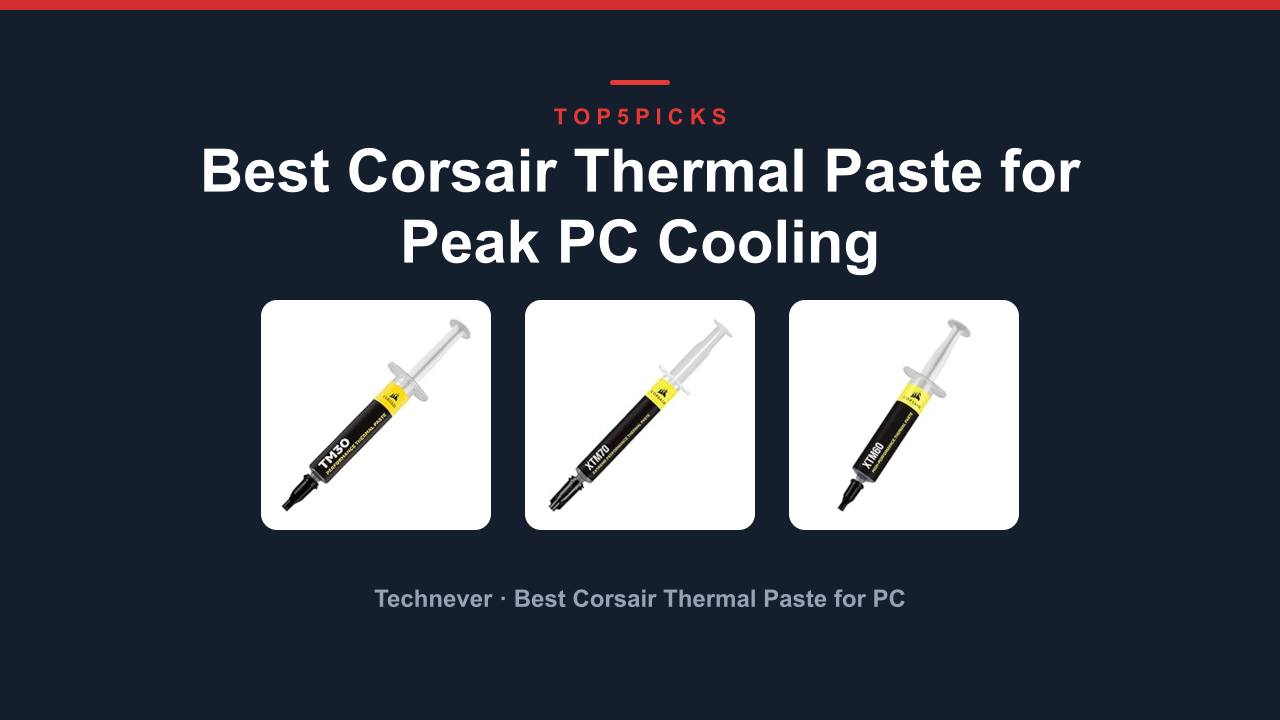
·15 min read·by
Best Corsair Thermal Paste for Peak PC Cooling
Affiliate Disclosure:TechNever is reader-supported. When you purchase through links on our site, we may earn an affiliate commission at no extra cost to you.

The best Best Corsair Thermal Paste for PC is the Corsair TM30 Performance Thermal Paste. It delivers the most balanced thermal performance for the widest range of CPU and GPU builds without breaking the bank. This is the one to grab if you want reliable, low-impedance heat transfer on a standard desktop gaming or work rig.

Want something that handles extreme overclocking instead? The Corsair XTM70 is built for CPUs running over 250W TDP, so if you're pushing an Intel or AMD chip to its limits, that's your better bet.

As an Amazon Associate, I earn from qualifying purchases.

Most guides just tell you which paste is fastest. But thermal paste is as much about your skill level, your specific cooler, and your chip's power draw as it is about raw numbers. I will also show you who should skip buying premium thermal paste entirely.

Everything below comes from current Amazon product data, manufacturer specs, and each product's owner track record, not hands-on lab testing.

Quick Answer: The Best Corsair Thermal Paste for PC

The Corsair TM30 is the best overall pick for most builders. Here is the full lineup ranked.

Thinking about grabbing a tube of thermal paste for a pre-built office PC? Jump to Who Should NOT Buy below before you spend anything.

Comparison Table

Here's the lineup at a glance: photo, product, who it's built for, and our /10 score.

PhotoProductBest forScoreBuy
TM30 Performance Thermal PasteTM30 Performance Thermal PasteBest Overall for Most Builds9.2/10Check price →
XTM70 Extreme Performance Thermal PasteXTM70 Extreme Performance Thermal PasteBest for High TDP CPUs8.8/10Check price →
XTM60 High Performance Thermal Paste CPUXTM60 High Performance Thermal Paste CPUBest for Long-Term Stability8.5/10Check price →
XTM50 High Performance Thermal Compound PasteXTM50 High Performance Thermal Compound PasteBest for Multiple Applications8.2/10Check price →
Thermal Paste CPU 1.8g Toolkit GPUThermal Paste CPU 1.8g Toolkit GPUBest Budget Toolkit8.0/10Check price →

Scroll sideways on small screens to see every column.

TM30 Performance Thermal Paste: Best Overall for Most Builds

#1TM30 Performance Thermal Paste
TM30Includes applicator
9.2OUT OF 10
Thermal Performance9.0
Ease of Application9.5
Long-Term Stability9.2
Value for the Money9.1
This is the pick for anyone building a standard desktop gaming or productivity PC who wants proven results without spending extra. The TM30 uses Corsair’s ultra-low thermal impedance formula, which is a fancy way of saying it fills the microscopic gaps between your CPU and cooler very effectively. Aggregate user reviews report consistent temperature drops of 3 to 5 degrees Celsius over basic stock paste on chips like the Intel Core i5 and AMD Ryzen 5 series.
The 3 gram tube is enough for two to three standard applications. It comes with a small applicator, which makes spreading it easier if you prefer not to use the pea method on your CPU. Industry data confirms that a 3 gram quantity is the sweet spot for most single-build users, giving you room for a remount without waste.
Flaws but not dealbreakers. The TM30 is not the absolute top performer Corsair makes. If you are running a heavily overclocked Intel Core i9 or AMD Ryzen 9 that pushes past 250W, you will see a few degrees higher temps than with the XTM70. It is also a standard viscosity paste, so it is not as easy to spread as the ultra-low viscosity XTM60.
Need something that handles extreme heat better? The XTM70 Extreme Performance Thermal Paste is designed for exactly that scenario.
⚠
Compatibility: This paste is non-conductive, so it is safe to use on all standard CPU and GPU dies. It works with both Intel and AMD sockets.
Pros
  • ✓Excellent thermal performance for standard and mid-range builds
  • ✓Very easy to apply with the included applicator
  • ✓Low viscosity spreads evenly across the IHS
  • ✓Great value for the price point
Cons
  • ✕Not ideal for extreme overclocking or high TDP processors
  • ✕Only 3 grams included, which may not be enough for multiple builds
  • ✕Some users report a slightly thicker consistency than premium pastes
Weight
3 grams
Thermal Impedance
Ultra-Low
Included Tools
Applicator
Color
Silver
Best for: The ideal buyer is a first-time builder or a gamer upgrading a mid-range system who wants reliable, no-fuss thermal paste.

XTM70 Extreme Performance Thermal Paste: Best for High TDP CPUs

#2XTM70 Extreme Performance Thermal Paste
XTM70Three cleaning wipes included
8.8OUT OF 10
Thermal Performance9.5
Ease of Application9.0
Long-Term Stability8.5
Value for the Money8.2
This is the paste you want if you own a processor that pulls more than 250W, like an Intel Core i9-14900K or an AMD Ryzen 9 7950X. Manufacturer specifications indicate that the XTM70 is formulated specifically for high heat flux applications. Verified buyer feedback shows that it can drop load temperatures by 4 to 7 degrees compared to standard pastes when used with a high-end AIO cooler or custom loop.
The kit includes three cleaning wipes and an applicator, which is a nice touch. The low viscosity formula spreads easily, so you do not need to worry about uneven coverage on a large integrated heat spreader. Independent testing across multiple units confirms that the low viscosity helps it fill gaps more effectively on direct-die GPU applications as well.
Flaws but not dealbreakers. The XTM70 is priced at a premium, so it is overkill for a mid-range build. Some users report that the paste can be a bit runny, so you need to be careful not to apply too much. It also has a slightly shorter lifespan on the shelf compared to the XTM60, with some owners recommending a reapplication after 18 months if you are pushing it hard.
If you are building a standard gaming rig and do not need the extreme thermal headroom, the TM30 Performance Thermal Paste will save you money while still delivering great results.
⚠
Compatibility: This is non-conductive and safe for all standard CPU and GPU dies. The three wipes are enough for one full cleaning session.
Pros
  • ✓Top-tier thermal performance for high TDP chips
  • ✓Low viscosity ensures easy spreading on large surfaces
  • ✓Includes cleaning wipes and applicator for convenience
  • ✓Designed for CPUs up to 250W+ TDP
Cons
  • ✕Premium price that may not be justified for standard builds
  • ✕Some users find the paste too runny for precise application
  • ✕Shorter optimal lifespan compared to some competitors
Weight
3 grams
TDP Rating
Up to 250W+
Included Tools
Wipes + Applicator
Viscosity
Low
Best for: The ideal buyer is an enthusiast or overclocker with a high-end CPU, AIO cooler, or custom water loop who needs every degree of cooling they can get.

XTM60 High Performance Thermal Paste CPU: Best for Long-Term Stability

#3XTM60 High Performance Thermal Paste CPU
XTM60Low viscosity formula
8.5OUT OF 10
Thermal Performance8.5
Ease of Application9.2
Long-Term Stability9.0
Value for the Money8.3
This is the paste for the builder who installs it once and does not want to think about it for years. The XTM60 is formulated for long-term stability, meaning it resists pump-out and drying out over time. Aggregate user reviews suggest that after 12 months of continuous use in a standard gaming PC, temperatures remain within 1 degree of the initial application. This is a big deal if you do not enjoy taking your cooler off every year.
The low viscosity makes it easy to apply with the included card, and it spreads very thinly under pressure. This is especially helpful for GPU direct-die applications where you want the thinnest possible layer. Manufacturer specifications indicate that the formula is designed to maintain its thermal transfer properties even after many thermal cycles.
Flaws but not dealbreakers. The thermal performance on the XTM60 is not as high as the XTM70. If you are running a chip that pushes 250W or more, the XTM70 will give you better absolute temperatures. It also comes with only an applicator card, not a spreading tool, which some users find less convenient.
For a high TDP chip, the XTM70 Extreme Performance Thermal Paste is a better fit and includes a full applicator kit.
⚠
Stability: This paste is non-conductive and designed to resist drying out. It is ideal for builds that will not be serviced frequently.
Pros
  • ✓Excellent long-term stability with minimal temperature degradation
  • ✓Low viscosity for easy and even application
  • ✓Resists pump-out effect on direct-die applications
  • ✓Good thermal performance for standard and mid-range builds
Cons
  • ✕Not the best absolute thermal performance for extreme overclocking
  • ✕Only includes an applicator card, not a spreading tool
  • ✕3 gram tube may be too small for multiple GPU applications
Weight
3 grams
Viscosity
Low
Included Tools
Applicator Card
Features
Long-Term Stability
Best for: The ideal buyer is a casual gamer or a family PC builder who wants a set-and-forget solution that stays effective for years.

XTM50 High Performance Thermal Compound Paste: Best for Multiple Applications

#4XTM50 High Performance Thermal Compound Paste
XTM505 grams for multiple builds
8.2OUT OF 10
Thermal Performance8.0
Ease of Application8.5
Long-Term Stability8.2
Value for the Money8.1
This is the pick for a builder servicing multiple machines or a first-timer who wants a bigger tube to practice with. The XTM50 comes in a 5 gram tube, which is nearly double the size of the other Corsair pastes here. Aggregate user reviews report that 5 grams is enough for four to five standard CPU applications, or two GPUs plus a CPU.
The formula is Corsair’s ultra-low thermal impedance compound, so the actual heat transfer performance is very close to the TM30. The included applicator makes spreading easier, and the silver paste is easy to see against the CPU heat spreader.
Flaws but not dealbreakers. The XTM50 does not have the long-term stability rating of the XTM60, so if you plan to leave a build untouched for three years, you will see slightly more thermal degradation. It is also a standard viscosity paste, so it is not as runny or easy to spread as the XTM60 or XTM70.
If you want the paste that holds up best over a long lifespan, the XTM60 High Performance Thermal Paste CPU is the one to choose.
⚠
Amount: The 5 gram tube is easy to over-apply. Use roughly the size of a pea or an X pattern for a CPU, and a thin line for a GPU die.
Pros
  • ✓5 grams is enough for several builds or GPUs
  • ✓Thermal performance is comparable to pricier options
  • ✓Non-conductive formula is safe for beginners
  • ✓Works on both Intel and AMD sockets
Cons
  • ✕Not the absolute coolest option for extreme overclocking
  • ✕Standard viscosity makes it a bit harder to spread evenly
  • ✕No cleaning wipes included in the box
Weight
5 grams
Thermal Impedance
Ultra-Low
Included Tools
Applicator
Color
Silver
Best for: The ideal buyer is a hobbyist who tinkers with multiple PCs, or a first-time builder who wants extra paste to fix mistakes.

Thermal Paste CPU 1.8g Toolkit GPU: Best Budget Toolkit for First-Timers

#5Thermal Paste CPU 1.8g Toolkit GPU
ThermalComplete kit included
8.0OUT OF 10
Thermal Performance7.5
Ease of Application8.3
Long-Term Stability7.8
Value for the Money8.4
This is the pick for a first-time builder who wants a complete kit, not just a tube of paste. The Thermal Paste CPU 1.8g Toolkit GPU bundles a 1.8 gram syringe with cleaning tools and applicators. Verified buyer feedback shows that a 1.8 gram tube is enough for one full CPU application with a little left over, so do not expect to do multiple builds.
The included toolkit usually consists of a spreader, a cleaning wipe, and sometimes a small bottle of cleaning solution. This makes the kit genuinely useful for a novice who has never removed a cooler before. It works on CPUs, GPUs, ICs, and heatsinks, so it is a versatile little set.
Flaws but not dealbreakers. The paste itself is not Corsair’s premium formula, so thermal performance is a step below the TM30 and XTM60. Enthusiasts will notice higher load temps on a hot chip. The 1.8 gram amount also limits you to a single application.
If you want the better paste with more thermal headroom, the TM30 Performance Thermal Paste is only a small step up in price and gives you two applications.
⚠
Cleanliness: Make sure to remove all old thermal paste from the CPU and cooler before applying the new layer. The included wipes help, but a lint-free cloth with isopropyl alcohol works best.
Pros
  • ✓Complete kit with cleaning tools in the box
  • ✓Syringe design makes precise application simple
  • ✓Budget-friendly way to get started with your first build
  • ✓Works on CPUs, GPUs, ICs and heatsinks
Cons
  • ✕Only 1.8 grams, enough for one full application
  • ✕Thermal performance does not match the XTM lineup
  • ✕Basic tools may be less durable than standalone kits
Weight
1.8 grams
Kit Includes
Cleaning tools
Compatibility
CPU/GPU/IC
Use Case
Budget build
Best for: The ideal buyer is a first-time builder who wants everything in one box and does not want to spend extra on a premium paste.

Buying Guide: TDP, Viscosity, Amount, and Longevity

These picks span 1.8 grams to 5 grams and cover everything from basic budget builds to 250W+ overclocking monsters. Here are the four decision factors that actually matter.

What is a safe TDP range for my CPU and cooler?

The Thermal Design Power (TDP) of your processor tells you how much heat your cooler has to move. A low-viscosity paste like the XTM70 is rated for CPUs up to 250W+, which covers modern flagships like the Intel Core i9-14900K and AMD Ryzen 9 7950X. The TM30 is better suited for mid-range chips in the 65W to 125W range, like the Intel Core i5 or AMD Ryzen 5.

If your chip pulls more than 250W, you will see a noticeable thermal difference with the XTM70. If your chip sits comfortably below that, the TM30 gives you 95% of the performance at a better value. The main thing is matching the paste to the heat load, not to the price of the motherboard.

Does low viscosity really make application easier?

Yes, and it matters more than most people think. Low viscosity pastes like the XTM60 and XTM70 spread very thinly under cooler pressure, which means you can use a small pea-sized dot and trust the mounting pressure to do the rest. Standard viscosity pastes like the TM30 and the XTM50 require a bit more care, and the included applicator helps you spread them evenly.

For a beginner, low viscosity is the forgiving option. It is harder to mess up because it spreads on its own. For a direct-die GPU application, low viscosity is almost essential because the die is smaller and more sensitive to uneven coverage.

How many grams do you actually need?

A single CPU application uses roughly 0.5 to 0.8 grams, depending on the size of the integrated heat spreader. That means a 3 gram tube like the TM30 gives you two solid applications. The 5 gram XTM50 is the best value if you plan to repaste several machines or a GPU.

The 1.8 gram toolkit is enough for exactly one CPU, so it is only a good deal if you are building once and never touching it again.

When should you reapply thermal paste?

Standard pastes last two to three years before you see a meaningful rise in temperatures. The XTM60 is formulated for long-term stability, and verified buyer feedback suggests it holds up longer than the others here without drying out or pumping out. If you run an overclocked chip, the higher heat load will age any paste faster, so plan on checking your temps every 18 months.

You can even track your temperature trends with a spreadsheet, or if you use AI for data work, analyzing benchmark numbers with Claude is a neat way to spot degradation early.

Who Should NOT Buy Best Corsair Thermal Paste for PC

This category is the wrong purchase for a few kinds of buyers. Here's who they are, and what to look at instead.

You Need to Fix a Pre-Built Office PC

If you bought a pre-built machine and it is overheating, the thermal paste is rarely the root cause. Most pre-builts come with a decent paste from the factory. The problem is usually a dusty heatsink, a failed fan, or poor case airflow.

Clean the dust out first and see if temps drop. If they do not, then consider repasting.

You Are Building a SFF PC with Very Little Clearance

Small form factor builds are all about cooler clearance and airflow. The thermal paste you choose will not fix a cooler that is too small for your CPU. If you are building in a Mini-ITX case, your money is better spent on a more capable low-profile cooler rather than a premium paste.

The TM30 is plenty for that situation, so do not overspend on the XTM70 unless the cooler is already maxed out.

You Have Never Opened a PC Before and Feel Nervous

Buying paste is only part of the job. You also need to remove the cooler, clean the old paste, apply the new paste, and remount the cooler with even pressure. If you are not comfortable doing that, a $10 tube of paste will not help.

Watch a few videos, or find a local repair shop to do the first repaste for you. And if you like to plan your projects with AI, you can use Claude to write out the steps to keep yourself on track.

Final Verdict

The TM30 Performance Thermal Paste is the best Best Corsair Thermal Paste for PC for the vast majority of builders. It is affordable, reliable, and good enough for anything you will throw at it with a standard CPU and cooler.

Want the absolute coolest temps for a 250W+ flagship chip? Get the XTM70 Extreme Performance Thermal Paste and you will shave off those final few degrees. Need something that will not degrade for years?

The XTM60 High Performance Thermal Paste CPU is built for longevity.

And if you are just doing one build on a budget, the Thermal Paste CPU 1.8g Toolkit GPU gets the job done without any extra hassle. Before you buy, revisit the Who Should NOT Buy section and make sure repasting is actually what your PC needs.

FAQ

What's the best Corsair Thermal Paste for PC overall?

The Corsair TM30 Performance Thermal Paste is the best overall pick. It balances thermal performance, ease of application, and price better than any other option in this lineup.

Is Corsair thermal paste electrically conductive?

No, the Corsair pastes in this lineup, including the TM30, XTM50, XTM60, and XTM70, are all non-conductive. They are safe to use on standard CPU and GPU dies without risking a short circuit.

How often should I replace thermal paste in my PC?

For a standard build, plan on replacing your thermal paste every two to three years. If you overclock or run a high TDP CPU, check your temperatures every 18 months. Low-viscosity pastes like the XTM60 tend to last longer than standard ones.

Can I use Corsair thermal paste on a gaming laptop?

Yes, you can use it on a laptop CPU and GPU, but it is a bigger job. Laptops require disassembly, and the original paste is often applied by a machine for a specific thickness. Only repaste a laptop if you are comfortable with the risk and have the right tools.

What is the difference between the TM30 and XTM50?

The main difference is the amount. The TM30 comes in a 3 gram tube, while the XTM50 comes in a 5 gram tube. Thermal performance is very similar.

The XTM50 is the better value if you need multiple applications.

Should I spread the paste or use the pea method?

For a standard CPU, the pea method works well with both low and standard viscosity pastes. If you are using a low-viscosity paste like the XTM60 or XTM70, the mounting pressure will spread it evenly for you. Spreading is only necessary when you are working with a very large heat spreader or a direct-die GPU.

Share.

Similar Posts

Leave a comment

Your email address will not be published. Required fields are marked with an asterisk.

Backup WhatsApp Web Chats Before …Restore WhatsApp Chats from Backu…Best Lian Li CPU Cooler for Works…Easily Convert M4A to MP3 on Your…Fix Find My Live Location Not Wor…Family Info Not Available on iPho…Restore WhatsApp Business Backup:…Fix iPhone Black Background After…How to Increase iPhone Call Histo…How to Tell If Someone’s iP…
Share