Best Cyberpower UPS for Your Home Lab
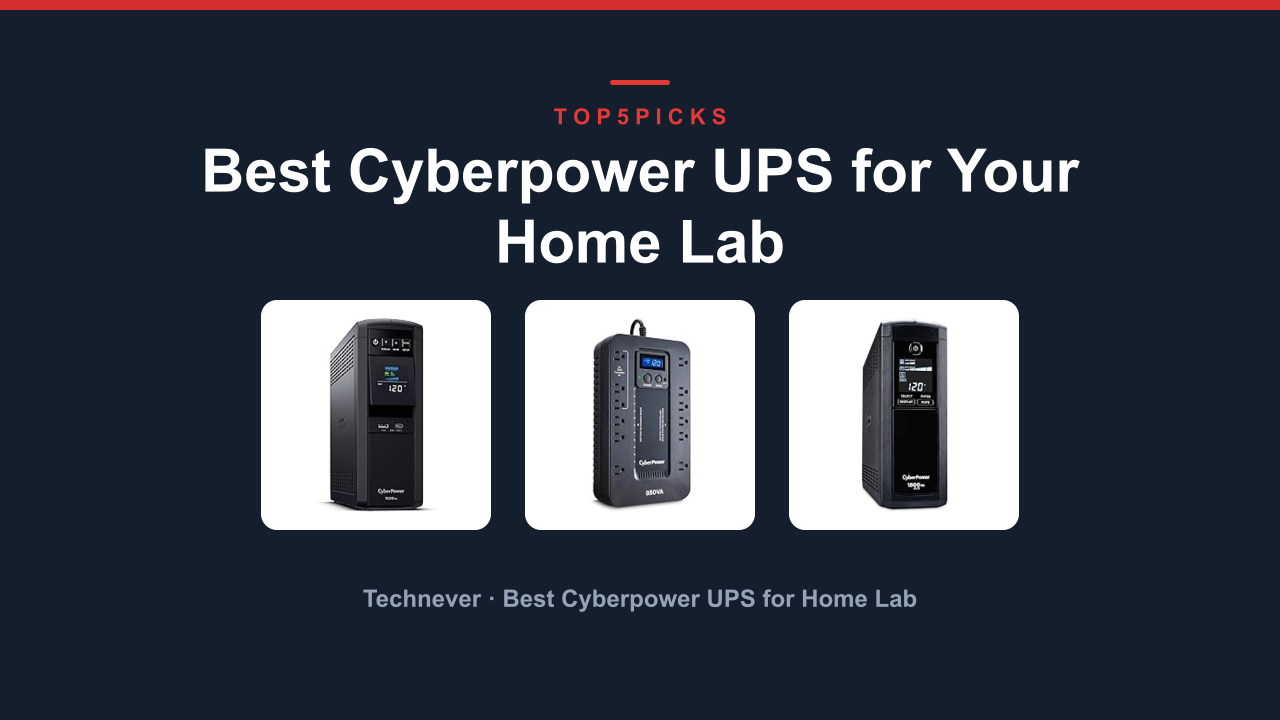
The best Best Cyberpower UPS for Home Lab is the CP1500PFCLCD PFC Sinewave UPS Battery Backup, the only model here that delivers true pure sine wave output for Active PFC power supplies found in most home lab servers, NAS units, and network gear. It's built for homelabbers who need clean, reliable battery backup without risking equipment damage from simulated sine wave.
Want a more budget-friendly option instead? The EC850LCD Ecologic gets you there, as long as you can work within its lower 510W capacity for a lighter lab setup like a single router, switch, and mini PC.
As an Amazon Associate, I earn from qualifying purchases.
This guide tells you what VA rating your lab actually needs, why sine wave vs. simulated wave matters for sensitive equipment, and which buyers should skip consumer UPS units entirely. The section after the reviews covers exactly who that is.
Everything below comes from current Amazon product data, manufacturer specifications, and each model's owner track record, not hands-on lab testing.
- Quick Answer: The Best Cyberpower UPS for Home Lab
- Comparison Table
- CP1500PFCLCD PFC Sinewave UPS Battery Backup: Best Overall for Home Labs
- EC850LCD Ecologic UPS Battery Backup Surge: Best Budget for Light Labs
- CP1500AVRLCD Intelligent LCD UPS Battery Backup: Best Value Mid-Range
- OR2200PFCRT2U PFC Sinewave UPS Battery Backup: Best High-Capacity Rackmount
- SL700U Standby UPS Battery Backup Surge: Best Slim Profile for Basics
- Buying Guide: VA Rating, Waveform Type, Outlet Count, and Form Factor
- Who Should NOT Buy a Cyberpower UPS for Home Lab
- Final Verdict
- FAQ
Quick Answer: The Best Cyberpower UPS for Home Lab
The CP1500PFCLCD PFC Sinewave UPS is the clear winner for home lab use. Here's the full lineup ranked:
- CP1500PFCLCD PFC Sinewave UPS Battery Backup (Best Overall for Home Labs): Pure sine wave, 1000W capacity, and 12 outlets for serious lab gear.
- OR2200PFCRT2U PFC Sinewave UPS Battery Backup (Best High-Capacity Rackmount): 1540W of pure sine wave power in a 2U rack form factor.
- CP1500AVRLCD Intelligent LCD UPS Battery Backup (Best Value Mid-Range): 900W capacity with AVR for voltage regulation at a sensible price.
- EC850LCD Ecologic UPS Battery Backup Surge (Best Budget for Light Labs): Compact 510W unit with ECO mode for energy savings.
- SL700U Standby UPS Battery Backup Surge (Best Slim Profile for Basics): Ultra-slim 370W unit for basic router and modem backup.
Thinking about a basic surge protector instead? Jump to Who Should NOT Buy below before you spend anything.
Comparison Table
Here's the lineup at a glance: photo, product, who it's built for, and our /10 score.
| Photo | Product | Best for | Score | Buy |
|---|---|---|---|---|
 | CP1500PFCLCD PFC Sinewave UPS Battery Backup | Best Overall for Home Labs | 9.2/10 | Check price → |
 | EC850LCD Ecologic UPS Battery Backup Surge | Best Budget for Light Labs | 8.0/10 | Check price → |
 | CP1500AVRLCD Intelligent LCD UPS Battery Backup | Best Value Mid-Range | 8.5/10 | Check price → |
 | OR2200PFCRT2U PFC Sinewave UPS Battery Backup | Best High-Capacity Rackmount | 8.8/10 | Check price → |
 | SL700U Standby UPS Battery Backup Surge | Best Slim Profile for Basics | 7.5/10 | Check price → |
Scroll sideways on small screens to see every column.
CP1500PFCLCD PFC Sinewave UPS Battery Backup: Best Overall for Home Labs
EC850LCD Ecologic UPS Battery Backup Surge: Best Budget for Light Labs
CP1500AVRLCD Intelligent LCD UPS Battery Backup: Best Value Mid-Range
OR2200PFCRT2U PFC Sinewave UPS Battery Backup: Best High-Capacity Rackmount
SL700U Standby UPS Battery Backup Surge: Best Slim Profile for Basics
Buying Guide: VA Rating, Waveform Type, Outlet Count, and Form Factor
Choosing the right UPS for your home lab is not as simple as picking the biggest number. You need to match the unit to your specific gear. Here are the four factors that matter most.
How Much VA and Wattage Do You Actually Need?
A UPS is rated in VA (volt-amps) and watts. The wattage is the real limit. For a home lab, add up the power draw of every device you want to protect.
A typical lab with one server, one NAS, a switch, and a router pulls between 300W and 800W at idle. The CP1500PFCLCD at 1000W handles that well. A dual-server lab with storage arrays can push past 1200W, which is where the OR2200PFCRT2U at 1540W becomes necessary.
The EC850LCD at 510W is fine for a single mini PC and networking gear, but you will outgrow it quickly if you add a full tower server.
Pure Sine Wave vs. Simulated Sine Wave: Why It Matters
This is the most misunderstood spec in the UPS world. Pure sine wave output matches the clean power from your wall outlet. Simulated sine wave (also called stepped approximation) uses a choppy waveform that can cause humming, overheating, or outright failure in Active PFC power supplies.
Most enterprise server PSUs from Dell, HPE, and Supermicro use Active PFC. If your server uses one, you need the CP1500PFCLCD or the OR2200PFCRT2U. If your lab uses older desktop power supplies or external power bricks, simulated sine wave from the CP1500AVRLCD or EC850LCD works fine and saves you money.
Outlet Count and Layout
More outlets are not always better if they are spaced poorly. The CP1500PFCLCD and CP1500AVRLCD each offer 12 outlets with 6 battery-backed. That is generous for a lab with multiple wall warts.
The OR2200PFCRT2U has only 8 outlets, but they are spaced for larger plugs. The SL700U has 8 outlets as well, but the slim form factor means some outlets are close together. Check whether your power bricks block adjacent outlets.
If they do, consider using a short power strip plugged into one battery outlet.
Form Factor: Tower vs. Rackmount
Most home labs start on a desk or shelf, making tower units like the CP1500PFCLCD and CP1500AVRLCD the natural choice. They sit upright or on their side. If you eventually move to a rack, the OR2200PFCRT2U in 2U rackmount form factor integrates cleanly.
The SL700U is uniquely slim for tight spaces. Measure your available depth before buying. The OR2200PFCRT2U needs about 24 inches of rack depth, while the tower units fit in 14 to 16 inches.
To see how these factors play out on real picks, compare the CP1500PFCLCD PFC Sinewave UPS Battery Backup, EC850LCD Ecologic UPS Battery Backup Surge and the CP1500AVRLCD Intelligent LCD UPS Battery Backup reviewed above.
Who Should NOT Buy a Cyberpower UPS for Home Lab
A UPS is the wrong purchase for three kinds of homelabbers. Here is who they are and what to look at instead.
You Only Need Surge Protection
If your power is stable and you only want to protect against surges from lightning or grid switching, a UPS is overkill. A good surge protector costs a fraction of the price and does the job for non-critical gear. The UPS adds battery backup that you will replace every few years.
If you do not need graceful shutdown capability, stick with a quality surge protector from a brand like Tripp Lite or APC. You can pair it with a simple power strip for additional outlets.
Your Lab Draws Over 1500W Continuously
The largest UPS in this lineup, the OR2200PFCRT2U, handles 1540W. If your lab pulls more than that at idle, you need a double-conversion online UPS or a larger unit from Cyberpower's industrial line. These units cost significantly more and require dedicated circuits.
Consider splitting your gear across two UPS units instead. For example, put your primary server on one OR2200PFCRT2U and your networking gear on a second CP1500PFCLCD.
You Need More Than 30 Minutes of Runtime
Consumer UPS units are designed for graceful shutdown, not extended runtime. Even the CP1500PFCLCD at 1000W will run for only about 10 to 15 minutes under a 500W load. If you need to keep your lab running through extended outages, you need a UPS that supports external battery packs.
Cyberpower offers models with expansion battery ports, but they are not in this lineup. For extended runtime, look at the Cyberpower CP1350AVRLCD with external battery capability or consider a generator as a supplement.
Final Verdict
The CP1500PFCLCD PFC Sinewave UPS is the best choice for most home lab owners. It delivers pure sine wave output, 1000W of capacity, 12 outlets, and AVR protection in a compact tower form factor. It is the only pick here that fully protects Active PFC power supplies without risk of damage or instability.
Want pure sine wave in a rackmount form factor? The OR2200PFCRT2U PFC Sinewave UPS gives you 1540W and slides into a standard 19-inch rack. It is the right choice for serious dual-server labs.
Need to save money on a lighter lab? The CP1500AVRLCD Intelligent LCD UPS offers 900W with AVR at a lower price, as long as your gear does not use Active PFC. The EC850LCD Ecologic UPS is a solid budget pick for a mini PC and networking stack under 400W.
If you are still unsure, check the Waveform section in the buying guide above. That single spec will tell you which unit fits your specific gear. And if you think you might not need a UPS at all, scroll back up to the Who Should NOT Buy section before you spend anything.
FAQ
What is the best Cyberpower UPS for home lab overall?
The CP1500PFCLCD PFC Sinewave UPS is the best overall pick. It delivers 1000W of pure sine wave output, 12 outlets, and AVR protection in a compact tower form factor. It is the only model in this lineup that fully protects Active PFC power supplies found in most modern servers.
Do I need pure sine wave for my home lab server?
If your server power supply uses Active Power Factor Correction (PFC), yes. Most enterprise servers from Dell, HPE, and Supermicro use Active PFC. A simulated sine wave UPS can cause humming, overheating, or even failure.
Check your PSU specifications. If it mentions Active PFC or PFC, choose the CP1500PFCLCD or OR2200PFCRT2U.
How long will a Cyberpower UPS run my home lab during a power outage?
Runtime depends on your load. The CP1500PFCLCD at 1000W will run a 500W load for roughly 10 to 15 minutes. The OR2200PFCRT2U at 1540W will run a 800W load for about 15 to 20 minutes.
Lighter loads like a router and modem on the SL700U can run for 30 to 45 minutes. These units are designed for graceful shutdown, not extended runtime.
Can I rackmount a Cyberpower UPS in my home lab rack?
Only the OR2200PFCRT2U is designed for rackmount use. It fits a standard 19-inch rack with 2U of vertical space. The other units are tower form factors and sit on a shelf or desk.
You can place tower units on a rack shelf, but they will not slide in flush.
How often do I need to replace the battery in a Cyberpower UPS?
Most Cyberpower UPS batteries last 3 to 5 years under normal use. The exact lifespan depends on how often the unit switches to battery power and the ambient temperature. The LCD display on the CP1500PFCLCD and CP1500AVRLCD shows battery health.
When the battery fails, you can replace it with a standard replacement battery pack from Cyberpower or a third-party equivalent.

Similar Posts